SUMMARY
A master logistics guide for international stone importers and contractors: 20ft container payloads, 2cm vs 3cm square meter capacities, seaworthy crating, and port handling.
Securing competitive B2B pricing through our project procurement desk is the first step in international natural stone procurement. The ultimate commercial success of any project depends on container payload optimization, weight distribution mathematics, and export packaging integrity. Because natural stone is among the heaviest commodities shipped via ocean freight, a miscalculated container load can result in port axle penalties, broken slabs, or excessive shipping surcharges.
This definitive logistics manual outlines payload limits, square-meter-to-weight conversions, seaworthy crating standards, and container stuffing protocols for shipping marble and travertine from Turkish container terminals.
1. Why Natural Stone Ships in 20-Foot Heavy-Duty Containers
In global maritime transport, natural stone is almost universally loaded into 20-foot Standard Heavy-Duty Containers (20' DV / HD) rather than 40-foot containers.
The reason is simple physics: - A 20-foot container reaches its maximum gross payload limit (typically 25,000 to 27,000 kg net stone payload depending on destination road regulations) long before it runs out of physical cubic volume. - Loading stone into a 40-foot container would leave 70% of the container empty while still hitting the legal road weight ceiling, generating unnecessary container equipment fees.
| Container Metric | European / International Standard Limit | US Road Weight Limit (Tri-Axle Required) |
|---|---|---|
| Max Stone Net Payload | 25,000 – 27,000 kg | 19,500 – 20,500 kg (without overweight permit) |
| Tare Weight of Container | ~2,200 kg | ~2,200 kg |
| Wooden Packaging Allowance | 800 – 1,200 kg | 800 – 1,000 kg |
| Max Gross Shipping Weight | 28,000 – 30,480 kg | 22,500 – 24,000 kg |
2. Square Meter Capacity by Slab and Tile Thickness
The specific gravity of metamorphic Turkish marble averages approximately 2,700 kg/m³, while cellular travertine averages 2,400 to 2,500 kg/m³. Calculating payload capacity requires exact thickness-to-weight conversions:
Marble Capacity Breakdown (Based on ~25,000 kg Net Weight Limit):
- 1.2 cm Calibration (Tiles): Weight = ~32.5 kg/m² → Capacity: ~750 to 800 m² per 20ft FCL
- 2.0 cm Calibration (Standard Slabs/Tiles): Weight = ~54.0 kg/m² → Capacity: ~420 to 460 m² per 20ft FCL
- 3.0 cm Calibration (Heavy Slabs/Steps): Weight = ~81.0 kg/m² → Capacity: ~280 to 310 m² per 20ft FCL
Travertine Capacity Breakdown (Based on ~25,000 kg Net Weight Limit):
- 3.0 cm Pavers / Coping: Weight = ~72.0 to 74.0 kg/m² → Capacity: ~330 to 360 m² per 20ft FCL
- French Pattern Sets (3.0 cm): Weight = ~74.0 kg/m² → Capacity: ~220 to 240 modular sets (~330 m²)
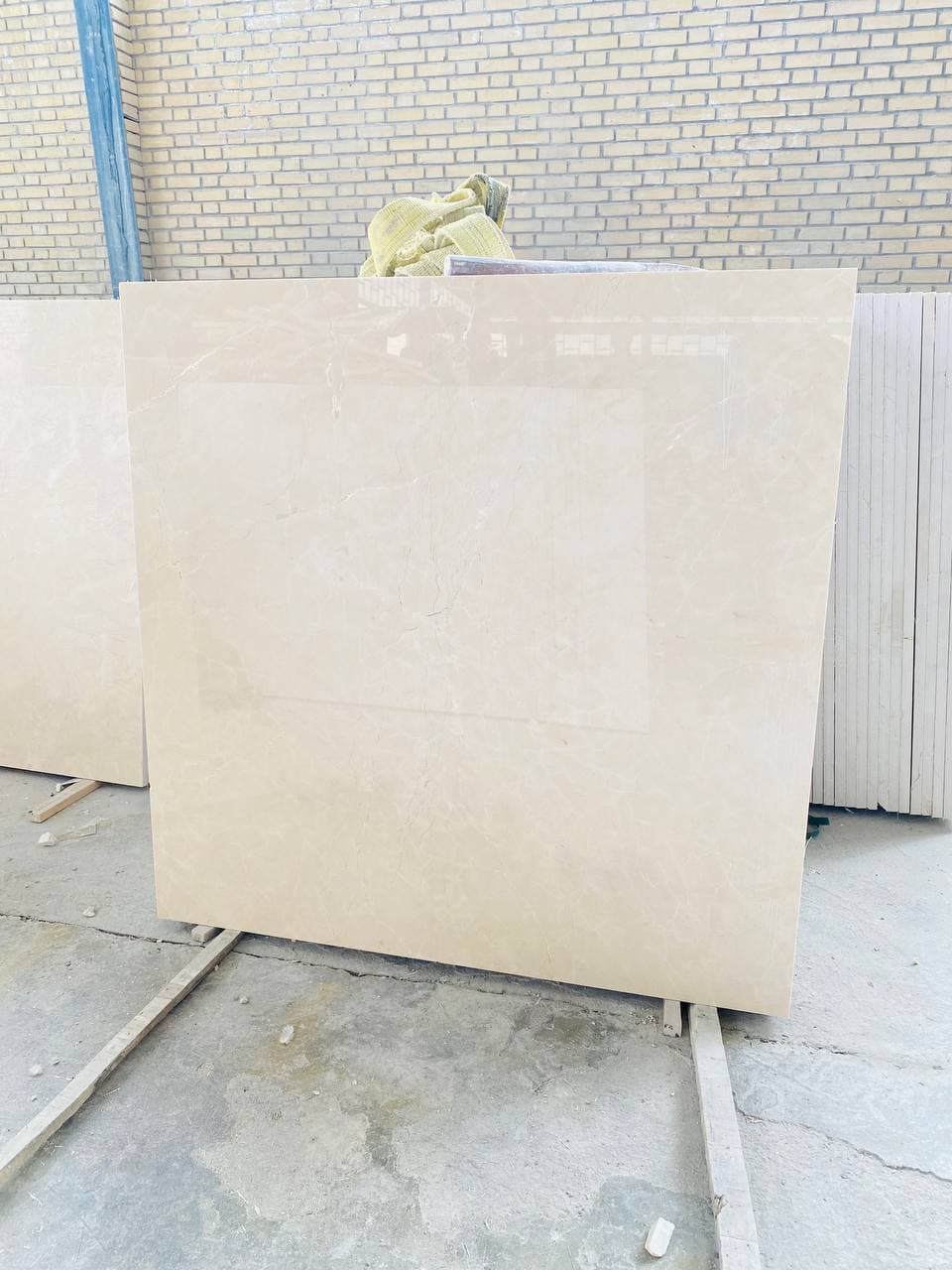
3. Export Packaging: Reinforced Wooden A-Frames vs. Closed Crates
Safe ocean transit across weeks of rough seas requires certified export timber packaging:
- Reinforced Wooden A-Frames (Gangsaw Slabs): Large gangsaw slabs (up to 300×180 cm) are stacked vertically on custom-engineered timber A-frames. Slabs are loaded face-to-face and back-to-back with protective plastic film between polished surfaces. Heavy steel tension banding secures the bundles directly to container floor tie-down rings.
- Seaworthy Wooden Crates (Cut-to-Size Tiles): Export wooden crates are constructed from solid kiln-dried timber stamped with heat-treatment phytosanitary marks. Crates are lined with polyethylene foam and reinforced with exterior galvanized steel strapping.
- Internal Dunnage & Airbags: Void spaces between crates are secured with heavy-duty industrial inflatable dunnage airbags and timber cross-bracing to prevent lateral cargo shifting during sea swells.
4. Port Logistics & FOB Export Terms
Burdur Marble manages container dispatch exclusively under standard FOB (Free on Board - Turkish Port) terms from Turkey's primary international maritime gateways: - Port of Izmir (Alsancak & Aliaga): Prime maritime hub for Western European, North American, and UK shipments with frequent weekly line services. - Port of Antalya: Strategically located nearest to Burdur quarries; optimal for Eastern Mediterranean and Middle Eastern trade routes. - Port of Mersin: Major commercial gateway servicing Arabian Gulf, Red Sea, and Asian markets.
Under our FOB supply model, Burdur Marble manages factory crating, domestic trucking, export customs clearance, and terminal vessel loading. The buyer manages ocean freight and destination customs clearance, ensuring complete commercial transparency.
Calculate your exact container weights and slab counts instantly using our B2B Container Calculator, or submit your project cut-list to our logistics team.
Specify & Procure Turkish Natural Stone
Burdur Marble exports high-density calibrated slabs and cut-to-size micro-beveled tiles with certified TS EN laboratory standards and FOB container logistics from Izmir and Mersin ports.
Burdur Beige vs. Spanish Crema Marfil
Follow Burdur Marble as a Preferred Source on Google
Stay ahead with our natural stone guides, technical specs, and architectural project analyses highlighted across Google Search and AI Overviews.